
NSW announces major EV push with new chargers and truck incentives


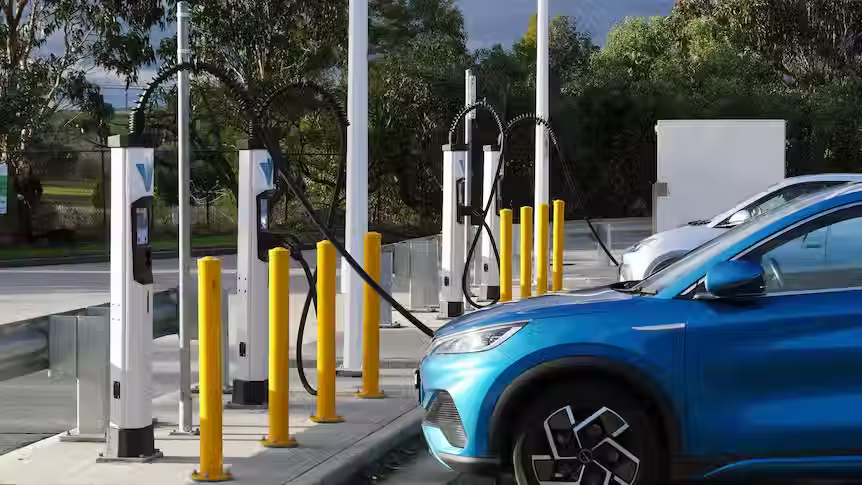
The New South Wales government has unveiled a major expansion of its electric vehicle (EV) strategy, including plans to roll out 1,000 additional public charging stations and provide support for businesses transitioning to electric trucks.
Backed by a $100 million investment, the initiative comes as EV adoption continues to rise across Australia, alongside increasing fuel prices driven by global instability affecting oil supply.
Recent data shows strong momentum in the market, with battery-electric vehicles making up a record share of new car sales in March. The second-hand EV market is also growing rapidly, reflecting broader consumer demand.
NSW Premier Chris Minns said the updated strategy is aimed at reducing costs for motorists while strengthening energy security and reducing reliance on international fuel markets.
The plan includes installing charging stations in underserved regional and suburban areas, as well as ensuring coverage along major highways at regular intervals. The goal is to make EV charging more accessible and convenient for all drivers.
Minns emphasised that electric vehicles should be accessible to a wider population, rather than limited to certain demographics. Expanding infrastructure is expected to play a key role in enabling more households to consider switching to EVs.
The government will also expand its existing fleet incentive program, which has already supported hundreds of organisations in adopting electric vehicles. The updated scheme will now include assistance for medium-sized electric trucks, helping businesses transition their freight operations.
In addition, funding will be allocated to train approximately 2,000 mechanics in regional areas, ensuring EV owners outside major cities have access to qualified servicing and maintenance.
NSW Energy Minister Penny Sharpe highlighted the long-term goal of creating a widespread charging network where drivers can easily access charging without planning around limited locations.
Further reforms are being explored, including policies to make it easier for residents in apartment buildings to install charging infrastructure. The government is also considering measures to streamline approval processes for new chargers, particularly where local council delays have slowed deployment.
Other proposals under review include installing charging points on existing power infrastructure, such as utility poles, although no final decision has been made.
Looking ahead, the state remains committed to introducing a road user charge for electric vehicles from July 2027. The proposed model would apply a per-kilometre fee to EV and plug-in hybrid drivers.
At the federal level, discussions are ongoing around a potential national approach to road user charging, with concerns raised about the need to avoid discouraging EV adoption during the transition phase.
Overall, the strategy signals a strong push by the NSW government to accelerate electric vehicle uptake, improve infrastructure coverage, and support businesses in shifting toward cleaner transport solutions.
Source: The Guardian Author: Original reporting by The Guardian This article is a rewritten summary based on publicly available reporting.


Comments